Blue Ocean Strategy And Digital Marketing
Blue Ocean Strategy And Digital Marketing
A number of well recognised brands have disappeared
over the last few years such as Blockbuster, Woolworths, Compaq, Republic and
Jessops – all recognised brands who at one stage were market leaders. So what’s
the common thread of these well-established traditional retailers not managing
to re-invent themselves as a digital brand?
- ‘Dont
find customers for your products, find products for your customers; putting the customer
at the centre of the conversation by interacting, engaging and using their
feedback to steer new opportunities to satisfy and delight users (e.g.
Threadless, Apple, 37Signals). The removal of the ‘us v them’ mentality
and building one to one communication with their customers through the use
of social media.
- Digital
disruption –
Start-ups who were prepared to take on the big brands and re-invent traditional
markets by eliminating running costs, reducing value chains and doing with
out bureaucratic systems and red tape that hinder large corporations in
reacting to a new competitor – here’s a great video of a small start-up re-writing the rules for bicycle
industry
Moving traditional companies to embrace the digital
age requires a cultural shift within an organisation and what your brand stands
for to a digital audience. Where brand loyalty was once a successful ingredient
towards brand survival, this has been replaced by an impatient digital audience
expecting to be delighted by brands that create remarkable products and
services and they frankly don’t care if the brand is well establised or not.
So how can brands re-position their proposition in
a digital world? What differentiates their product or service? And are they
listening to their audience?
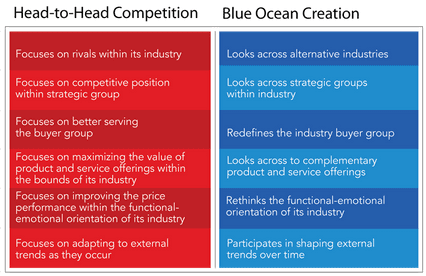
Blue Ocean Strategy
To review opportunities for differentiation, brands
need to consider embracing the Blue Ocean strategy which
is defined as creating an untapped market place. Created by W. Chan. Kim and
Renee Mauborgne, Blue Ocean Strategy suggests an organisation should look
to create a new demand in an uncontested market space. The opposite to the Blue
Ocean is the Red Ocean, which is where the existing competition is fighting it
out for market share with one another as explained below.
 By creating an
uncontested market space, a Blue Ocean provides you with the opportunity to
create a new demand for your product or service from an untapped customer base
and at the same time delight your existing customers.
By creating an
uncontested market space, a Blue Ocean provides you with the opportunity to
create a new demand for your product or service from an untapped customer base
and at the same time delight your existing customers.
Starbucks strategy
To put this into context, here are two brands that have successfully introduced this strategy, Starbucks and Threadless.
Starbucks – The largest coffee house in the world, was
operating in a highly competitive market place and needed to re-define its
proposition to its consumer base.
By turning the idea of having a cup of coffee into
a ‘way of life’ by redefining how customers can enjoy a Starbucks experience
through the coffee shop environment, introducing music and wi-fi in a relaxed
setting the company established a new market space which other coffee chains
ignored (or are now trying to replicate).
Below is a value curve which helps to create an
uncontested market place (blue ocean). The curve lists the common factors
competitors all compete on (ranking these from low to high importance):

Traditionally, the key factors coffee chains
compete on are: price, quality, availability & location of the
stores. Starbucks saw the opportunity to create new factors that none of its
competitors were doing which were:
- Variety - It’s not just about coffee, Starbucks have introduced a number of different products and drinks that cater for a wider audience which can be enjoyed in a social setting where customers can read, relax and socialise
- Customer Service – Starbucks focused on recruiting employees that were well trained and benefited directly from the organisations success thereby delighting customers
- Brand Aspiration - Accelerated Starbucks to become a global brand that created an aspirational brand which customers wanted to experience and became a “day-out” experience in meeting friends.
As you can see, variety, customer service and Brand
aspiration were not factors considered by the competition, hence providing
Starbucks with a route to differentiation and regard these factors as highly
valued to the organisation.
posted by Unknown @ 10:01
0 Comments


0 Comments:
Post a Comment
Subscribe to Post Comments [Atom]
<< Home